Data Annotation and Labeling: Complete Guide from Scratch
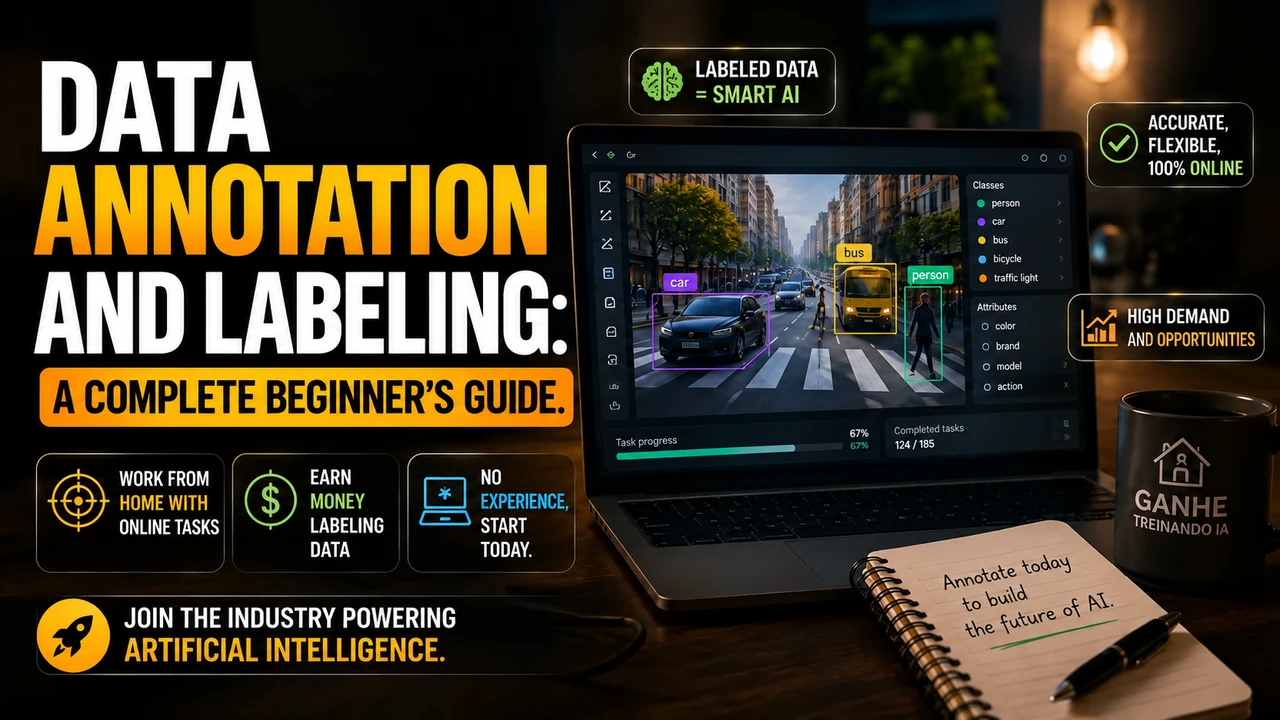
Before any AI model can learn anything, someone needs to prepare the raw material: mark where an object is in a photo, classify the sentiment of a sentence, indicate whether a transcription is correct. This invisible work has a name: data annotation, or data annotation — and it is the foundation on which the rest of this market was built.
This guide closes the set of guides for main article on types of paid tasks for training AI, detailing the oldest and most established front of this entire market — an area that existed long before the recent explosion of generative artificial intelligence.
The basis of everythingWhat is data annotation
The work that no one sees, but every model depends on it
Before any AI learned to recognize a cat in a photo or understand the sentiment of a sentence, someone manually marked: “that's a cat”, “that sentence is negative”. Without this human-annotated foundation, no supervised learning model works.
Without this layer of carefully applied human labor, the artificial intelligence models we use today simply would not exist as we know them — it is an essential, yet barely visible, piece of the entire AI production chain.
Companies like Appen have been in this sector for more than a decade, long before the current wave of generative AI — they were preparing data for search, machine translation and speech recognition systems long before terms like "ChatGPT" existed.
What has changed in recent years is not the existence of this work, but its scale. Larger models require increasingly greater amounts of quality annotated data, which has opened up space for more people to enter this market, even those without prior experience in technology — just patience, attention and a willingness to follow detailed instructions consistently over time.
The material you will write downAnnotation types
| Data type | What do you do |
|---|---|
| Image | Mark where an object is by drawing an outline around it |
| Text | Classify sentiment, intent, or category of a sentence |
| Audio | Mark the beginning and end of speech, identify who is speaking |
| Video | Track an object frame by frame throughout recording |
These four modalities cover most of what is required in note-taking projects today, and mastering even just one of them is enough to start generating extra income consistently.
It's worth noting that most initial projects start with text and images, as these are the simplest formats to learn how to annotate correctly without extensive training.
Each type of data uses a slightly different tool and logic, but the principle is always the same: transforming raw, disorganized material into clear, structured examples that an algorithm can learn from. The same project can involve several types of annotation in sequence — first transcribing an audio, then classifying the sentiment of the resulting text, for example.
It is worth noting that text annotation tends to be the most common gateway, as it requires less specific tool training. Video annotation, which involves tracking objects frame by frame, tends to be reserved for employees with an already established history on the platform, precisely because it requires more precision and consequently pays more per dedicated hour.
Not every annotation is worth the sameComplexity defines pay
A simple task — marking whether a sentence is positive or negative — pays less than a complex one — drawing precise contours around several objects in the same photo. Projects usually inform you of the level of complexity and the corresponding value before you accept the task, allowing you to consciously choose what you want to do.
There is a natural progression in this market: those who start with simple text classifications can, with time and a history of quality, migrate to more complex image or video annotations, which pay substantially more per hour of dedicated work. It is not uncommon for the hourly rate to double or triple as the complexity of the tasks accepted increases.
Neither hype nor exaggerationA real case: 2 hours per day, R$ 1,500 per month
A real report from the market
A Brazilian journalist reported having worked at Appen between 2019 and 2021, while still in college, translating, transcribing, collecting photos and videos, and image labeling. At his peak, he dedicated around 2 hours a day — 60 hours a month — supplementing his internship income in amounts close to R$1,500 per month, an amount that varied slightly depending on the dollar exchange rate during that specific period.
This report is useful precisely because it is modest: neither a promise of quick riches nor a scam. Real extra income, conditioned on dedicated time, complementing — not replacing — another main source of income.
What draws attention to this report is the variety of tasks carried out within a single platform: translation, transcription, collection and labeling, all alternated according to the availability of projects at that time. It's a common pattern in this market — few people are stuck with a single type of task, and the flexibility to switch is part of what makes this extra income sustainable over time.
Simple to use, no installationThe tools you will use
The vast majority of annotation projects run directly in the browser, in a ready-made visual interface — without having to install any programs. For an image, this is usually a screen where you draw an outline around the object with the mouse or your finger, in the case of a tablet. For text, these are usually category buttons to click. For audio and video, a timeline where you mark the beginning and end of each relevant event.
Each platform has its own tool, but the logic is always similar: view the material, apply the requested marking, confirm and move on to the next item. There is no significant technical learning curve — most of the training is on annotation criteria, not how to operate the software.
Many of these tools include keyboard shortcuts to speed up repetitive work — once you memorize the shortcuts for the most common task in your project, the pace of note-taking increases considerably, which directly impacts how much you can produce (and earn) per hour of work.
The most cited platformsWhere to start
- Appen: one of the most traditional, with variable translation, transcription and labeling projects
- DataAnnotation.tech: free registration, remote and asynchronous projects
- Remotetasks: subsidiary of Scale AI, focusing on image and text annotation
You don't have to choose just one. Many people register on two or three of these platforms simultaneously, alternating depending on the availability of projects on each one — the volume of available tasks varies week to week, and having more than one active option reduces periods without available work. This flexibility is one of the great advantages of this type of asynchronous remote work.
From registration to the first taskHow it works, step by step
- 01
Free registration
Account on the chosen platform, with no entry cost.
- 02
Qualification test
Small assessment that confirms whether you understand the tool.
- 03
First tasks
Start with simple, less complex notes.
- 04
Evolution
Consistency and quality free up more complex and better paid tasks.
The growth pathEvolving within the platform
Most note-taking platforms work by increasing reputation: the more tasks you complete with consistent quality, the more projects — and higher-paying projects — will be released to your profile. It's common to start with simple tasks and, after a few weeks of a clean record, be invited to specialized projects with higher pay.
This means that the first few days are often the least profitable — and that’s okay. View the beginning as a period of history building, not as the standard of what you will earn once you are established on the platform.
Some platforms publicly display your level or quality score within the dashboard, which helps you track your own progress and understand when you are close to unlocking the next tier of available projects. Monitoring this metric closely is a good way to know if it is worth continuing to invest time in that specific platform.
What to avoidMistakes that delay your evolution
- Rushing: marking objects or sorting data without following the guide carefully
- Inconsistency between similar tasks over time
- Skip reading the specific instructions for each new project
- Giving up too soon, before accumulating history that unlocks better tasks
A less obvious but common mistake: treating each task as an isolated event, without paying attention to feedback received from previous tasks. Most platforms provide some kind of feedback on the quality of your notes — ignoring this feedback and repeating the same mistakes is the quickest way to get stuck on the simplest and cheapest tasks.
Before the model learned anything, someone manually marked every example it saw. That someone could be you.
Still in doubt?FAQ
Do I need to know how to program to annotate data?
No. Annotation tools are visual and simple to use — you click, draw outlines, or select categories in a ready-made interface, without writing code.
What is the difference between annotation and AI assessment?
Annotation creates the database that trains the model for the first time (marking, classifying, labeling). Evaluation judges the quality of responses that the model has already generated. They are different stages of the same process.
How long does it take to start making money?
After registration and initial qualification, which usually takes from a few minutes to a few hours, you can now accept your first paid tasks.
Do more complex tasks pay better?
Yes. Segmenting objects in video frame by frame, for example, pays more than simple text classification, because it requires more time and precision.
Which platforms are mentioned most frequently in Brazil?
Appen, DataAnnotation.tech and Remotasks appear frequently in Brazilian reports, each with its own registration process and project types.