Make Money Recording Videos to Train AI: The Complete Guide for 2026

You may have already seen the advertisement: "make money watching videos on YouTube", "get paid to watch videos on TikTok". The account never closes — it’s pennies per hour, a points goal that never fills, withdrawals that slow down at a minimum. There is a reverse version of this work, and it really pays: instead of watching, you record.
In recent months, a wave of artificial intelligence companies have started paying ordinary people to record mundane everyday tasks — washing dishes, folding laundry, walking the dog — with their cell phones attached to a headband. The value is between R$25 and R$30 per approved hour, paid directly through PIX. It's not a promise to get rich overnight. It's real work, with clear rules and review deadlines, and that's exactly what this guide is about.
The work, no fussWhat is it in practice
The technical name is egocentric video, or POV — from English point of view, point of view. In practice, it's simple: you attach your cell phone to a headband, leave the camera pointed downwards, towards your hands, and record a common task the way you already do it every single day.
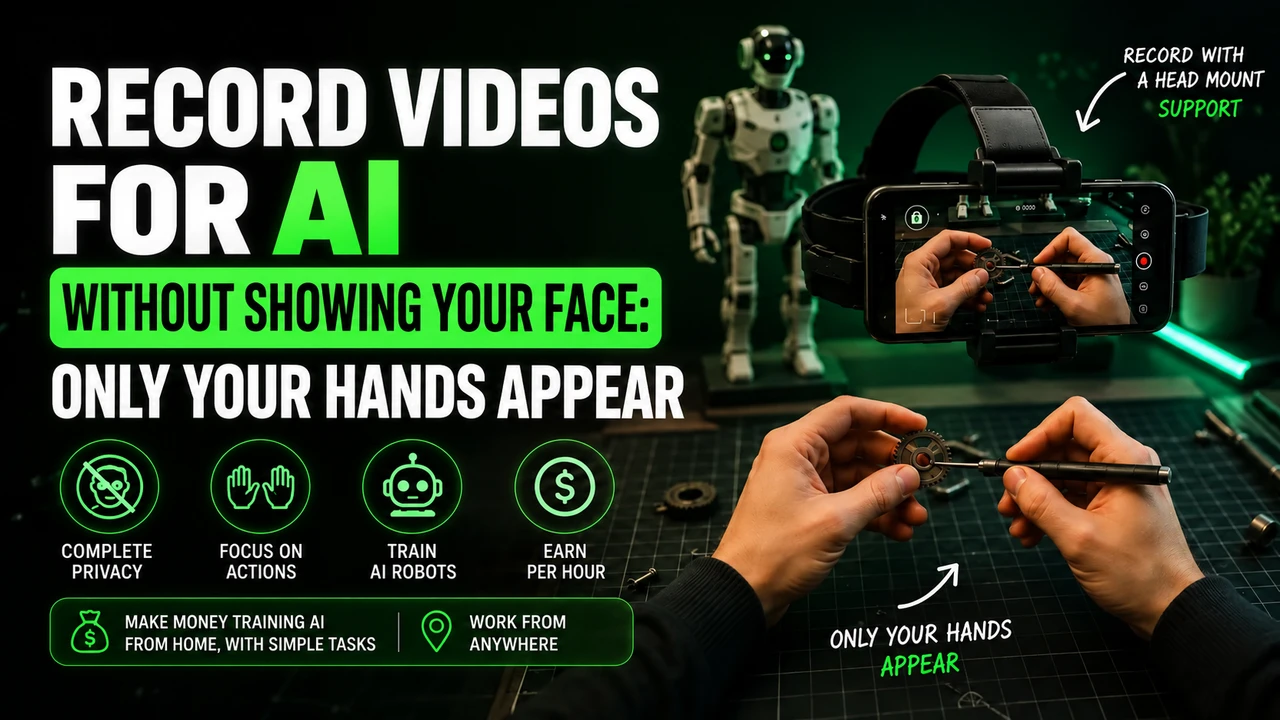
There's no scene to set up, there's no editing afterwards — and this is the detail that most reassures those who ask: your face doesn't appear. The camera looks where you look. What comes into the frame are your hands, the object you are manipulating and the surrounding environment.
Most platforms organize tasks into similar blocks: kitchen, laundry, home organization and a more open category that ranges from washing the car to watering plants. Hub, for example, catalogs more than 80 different tasks within the application itself, each with a short description of what needs to appear in the video — and some of them pay extra when they are "in demand", that is, when there is a lack of examples of that specific type in the company's database.
The context behind the moneyWhy does this exist now
It may seem strange at first — why would a company pay for a video of someone folding a towel? The answer has to do with a much bigger movement happening in the technology industry right now.
After years of training language models with practically all text available on the internet, AI companies have hit a ceiling: there is a lack of data from the physical world. A robot doesn't learn to wash dishes by reading a manual — it learns by watching thousands of real examples of human hands doing just that, in different sinks, kitchens and homes. This type of data does not exist ready to be scraped from the internet. It needs to be recorded, one video at a time.
Names like Figure AI, Tesla — with the Optimus project — and the Chinese company Unitree compete to place real robots inside homes, factories and hotels, and they all run into the same obstacle: there is a lack of people willing to record their daily lives to feed these models. That's where platforms like Hub Data, Claru, Crowtado, KGEN and the Brazilian Mimix AI come in — they bridge the gap between AI laboratories that need this data and ordinary people who already perform these tasks for free, every day, at home.
It makes sense to think of this as a kind of data shipping: You were going to wash the dishes anyway. The difference is to strap your cell phone to your head before you start.
The question everyone asks firstHow much does it really pay
The values change from platform to platform, but there is a range that is repeated in most reports from those who test this type of work in Brazil: between R$25 and R$30 per hour of approved video.
Note the detail: approved. Payment is not per hour recorded, it is per hour that passes the quality check. A two-minute task yields little — the calculation is always based on the total useful recording time, not the number of videos sent.
| Platform | Payment range* | Receiving | Learn more |
|---|---|---|---|
| Hub Data | R$25 to R$30/hour approved | PIX | Complete guide → |
| Claru | $6 to $25/hour depending on project | Wise/Payoneer | Complete guide → |
| Crowtado | Up to $40/hour on voice and video tasks | PIX / Mercado Pago | Complete guide → |
| Mimix AI | $5.00 / approved hour | Wise/Payoneer | Complete guide → |
| KGEN | Variable per mission | According to the mission | Complete guide → |
*Approximate values, collected in reports from those who use each platform and on official pages. They change depending on the campaign, country and dollar rate — always check the current value within the app before recording.
Doing the math realistically: one hour of recording per day, every day of the month, at R$ 25 per hour, is around R$750 monthly. It's real money — but with a caveat that anyone serious about it will tell you straight up.
Treat it as extra income, not salary
One hour a day at R$25 approved gives something close to R$750 per month — it's real money, but the volume of available tasks fluctuates from week to week. No serious page on the subject will promise high and guaranteed earnings. Consider it a supplement, especially in the first few weeks.
Do you want to delve deeper into this financial part — exact payment deadlines, conversion rates and how withdrawals work on each platform? We detail everything in the article how much do you earn recording videos for AI.
From zero to first paymentHow it works, step by step
The path between creating the account and receiving the first PIX basically follows the same logic on all serious platforms in the sector, with small variations in name and deadline:
- 01
Sign up
Create a free account on the official website of the chosen platform, with email and basic details.
- 02
Head strap
Order the free kit (when available) or buy a simple stand — it's the only real investment.
- 03
Link the app
Download the indicated recording application and connect to your account with the same email (or organization code).
- 04
Save the task
Choose a task from the list, read the instructions and record from beginning to end, without cuts.
- 05
Review
The video goes through quality checks — the deadline usually varies between 24 hours and 48 hours.
- 06
Withdrawal
Time approved becomes balance. You request withdrawal whenever you want, usually via PIX.
The detail that most disapproves of video
The cell phone is lying horizontally, attached to the forehead with the headband, tilted about 45 degrees downwards, and you record standing. Video recorded while sitting, with your cell phone held vertically, is one of the most common causes of failure — and it's easy to avoid once you know it.
A common mistake for beginners: giving up after the first failure. In the vast majority of cases, just adjust the angle and re-record the same task — it usually passes on the second try without any problems.
Where to registerPlatforms that pay in Brazil
We cover each of these platforms in detail, with step-by-step registration, payment methods and what to check before starting. Here is a summary of each:
- Hub Data — the most cited in Brazil today. American company with office in São Paulo, payment via PIX and its own recording app. See full guide →
- Claru — international projects ranging from housework to gaming, with wider pay ranges. See full guide →
- Crowtado — in addition to video, it accepts audio and photos via cell phone, with an interface in Brazilian Portuguese. See full guide →
- Mimix AI — the only genuinely Brazilian operation on the list, with 100% support in Portuguese. See full guide →
- KGEN — varied data collection missions, including audio and video. See full guide →
You don't need to choose just one. Many people who record constantly maintain accounts on two or three platforms at the same time, so as not to run out of work available during a slower week.
Where to focus your timeTasks that pay the most
As payment is per approved hour, the logic is simple: longer tasks with more steps tend to yield more than a two-minute recording. Furthermore, most platforms periodically prioritize certain categories — generally external area, vehicle and maintenance — paying an extra of around 20% on top of the standard rate while the shortage of that type of data lasts.
We detail the complete list of household tasks and the pet and garden routine in two specific guides: homework that pays the most e routine with pets, plants and garden.
Read before acceptingPrivacy: what to check before starting
What the terms of use usually say
On most of these platforms, the video sent — and its image, if it appears — becomes the property of the company, which can license or resell the material to AI and robotics laboratories. It's not a reason to panic, but it is a reason to be careful: avoid recording documents, password screens, children or anyone you haven't authorized to appear.
In practice, this translates into some simple rules that apply to any platform:
- Remove documents, correspondence and anything with your full address from the scene
- Never record cell phone or computer screens with a visible password, email or bank details
- Ask other people in the house to leave the room before recording
- Children should not appear in the video, even if it is just the voice in the background
We detail this topic in more depth — including how to configure the frame to ensure that only the hands appear — in the guide record video without showing your face.
Honest balance sheetIs it worth it? Pros and cons
It's worth it when…
- Real payment via PIX, without fussing over points or hidden goals
- No need to appear: just your hands enter the frame
- You can record at your own pace, without a fixed schedule or boss
- Free registration on most serious platforms
- A task is something you probably already do every day, for free
Think twice if…
- Only approved time generates payment — bad video is wasted time
- Task availability varies from week to week
- You can’t count on this as a fixed monthly income.
- Your videos become the property of the company
- Requires minimal investment in head strap
R$25 per hour approved is a real value and good for extra income — but the total time includes reading the task, assembling the setup and sometimes re-recording what was rejected.
Before recording the firstErrors that disapprove the video
The vast majority of rejections are repeated for the same reasons, regardless of the platform. It's worth reviewing this list before your first recording:
- Hands leaving the board in the middle of the task
- Video recorded sitting or with the cell phone vertical
- Dark environment, without natural light or lamps
- Task cut in half or edited after recording
- People or documents accidentally appearing in the background of the scene
- Submitting the wrong task, different from what the script requested
If a video is rejected, most of the time the problem is one-off and easy to fix. Adjust the angle, check the light and re-record — occasional rejection is normal, especially on the first attempts.
Still in doubt?FAQ
Do I need to show my face to record videos for AI?
No. The recording is made in first person, with the cell phone attached to a headband pointing downwards. What appears on the board are your hands and the task being performed, not your face.
Is it safe to record video to train artificial intelligence?
Generally speaking, yes, as long as you read the platform's terms before accepting. The point of attention is not a financial scam — it's privacy: avoid recording documents, screens with a password or other people without authorization, because the video sent becomes the company's.
How long does it take for the payment to go through?
Each video goes through a quality review that usually takes between 24 and 48 hours. Once approved, the amount is entered as the balance and the withdrawal — usually via PIX — can be requested whenever you want.
Which cell phone can I use to record?
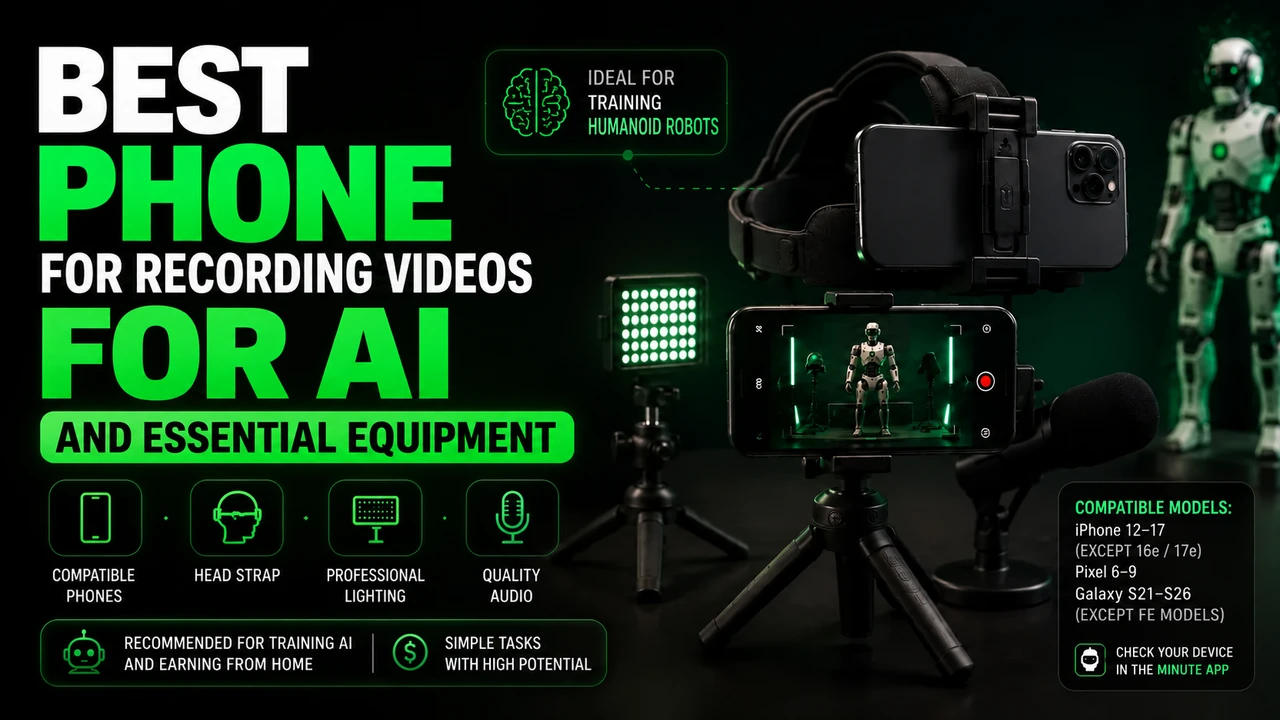
Most mid-range or high-end devices from recent years work as long as they record stable video in good resolution. We detail head strap requirements and options in the equipment guide.
Can you live on this alone, without other work?
It is not recommended to rely on this as your only source of income. The volume of available tasks varies, payment depends on approval and there is no guarantee of fixed hours. It works well as extra income, not as a substitute for employment.
Is there any Brazilian platform in this market?
Yes, Mimix AI is Brazilian, with support in Portuguese and payment of US$5 per approved hour. The others (Hub Data, Claru, Crowtado, KGEN) are international, but accept employees in Brazil.
Do I need to pay anything to get started?
No. Registration is free on all serious platforms we cover here. The only real cost is the head strap to hold the cell phone — and some campaigns even send this kit for free.
Keep Learning: Related Guides
Coming soon: Record video for AI in the kitchen, Hub Data vs Claru vs Crowtado: comparison, Errors that fail video (advanced guide)