Work Training AI: all types of paid tasks today
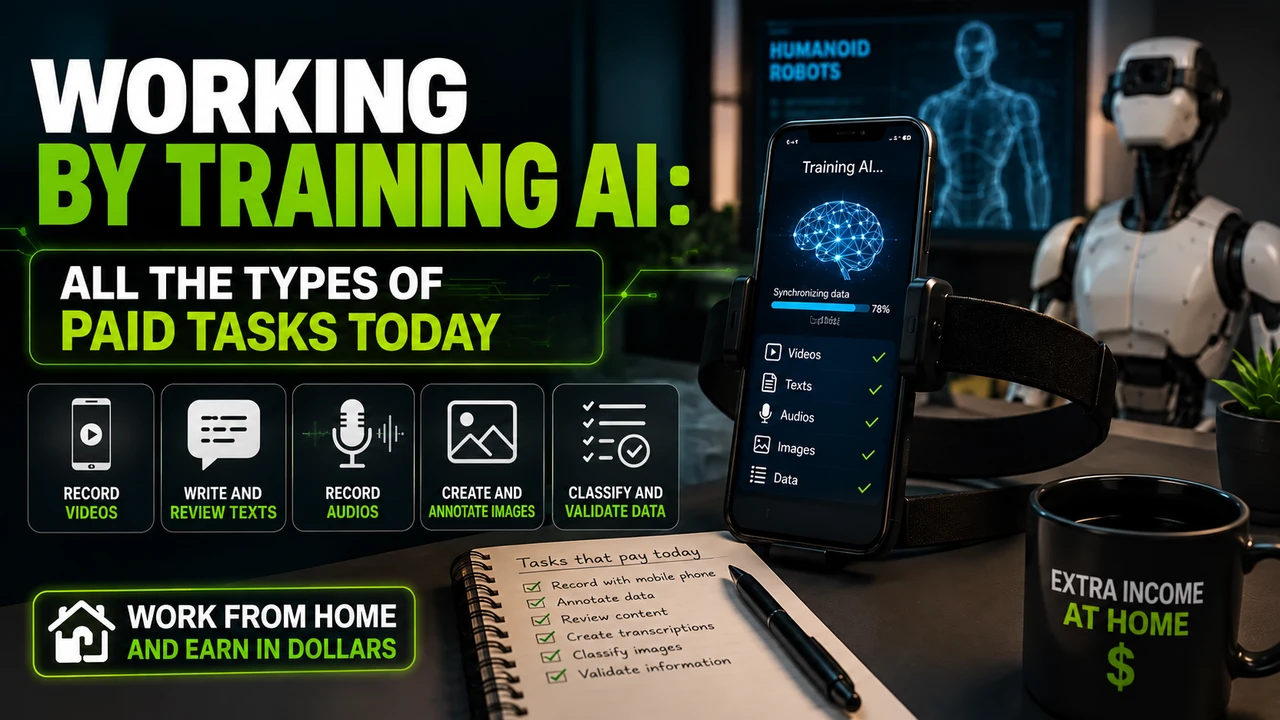
If you only know the part about recording video to train AI, you are only seeing a small slice of a much larger and much more diverse market. Artificial intelligence companies pay for virtually every type of human data they can collect — voice, photo, text, review, code, even specialized medical and legal knowledge.
Recording video is just the gateway
If you got here through our guide to recording videos to train AI, it’s worth knowing: video is just a slice of a much larger market. AI companies also pay for voice, photo, text, code, translation and even specialized knowledge in areas such as medicine and law.
The overviewBeyond the video: the complete map
This market has grown along with the AI industry itself. Every company that trains a model needs real people evaluating, correcting and generating examples — and this has created an entire economy of remote, flexible work, usually paid in dollars. Let's go by category.
It's worth understanding the logic behind so much variety: each type of AI model needs a different type of human data. A language model needs text and response evaluation. A voice model needs audio recorded by real people. A robotics model needs video showing human movement. That's why the market has fragmented into so many different fronts — each one feeds a specific type of technology.
What you already knowVideo and image
| Task | What is | Where to find |
|---|---|---|
| First person video (POV) | Record everyday tasks with a cell phone on your head | Hub Data, Claru, Crowtado, Mimix AI |
| Photos and image collection | Photograph specific objects, products and environments | Crowtado, Hub Data |
| AI-generated image evaluation | Compare and point out errors in images created by models | Multiple annotation platforms |
We've already covered this front in depth — it's probably the simplest entry point into this entire market, because it doesn't require English or technical qualifications. Start with complete video guide if you haven't read it yet.
Your voice is also worth moneyVoice and audio
| Task | What is | Track mentioned |
|---|---|---|
| Reading sentences/scripts | Read sentences aloud following a script | US$18 to US$40/h (Crowtado) |
| Dialogues and conversations | Recording a natural conversation between two people | $18 to $40/hr |
| Rare dialects | Speech samples in underrepresented regional variations | Higher ranges due to scarcity |
| Audio transcription | Listen to recordings and write down exactly what was said | Varies by platform |
Crowtado is the most explicit platform on pricing on this front, with an official published range of $18 to $40 per hour for voice duties. Less represented dialects and accents tend to pay in the higher range, precisely due to the scarcity of examples of that specific type of speech within the company's database.
Where English usually opens doorsText, evaluation and annotation
| Task | What is |
|---|---|
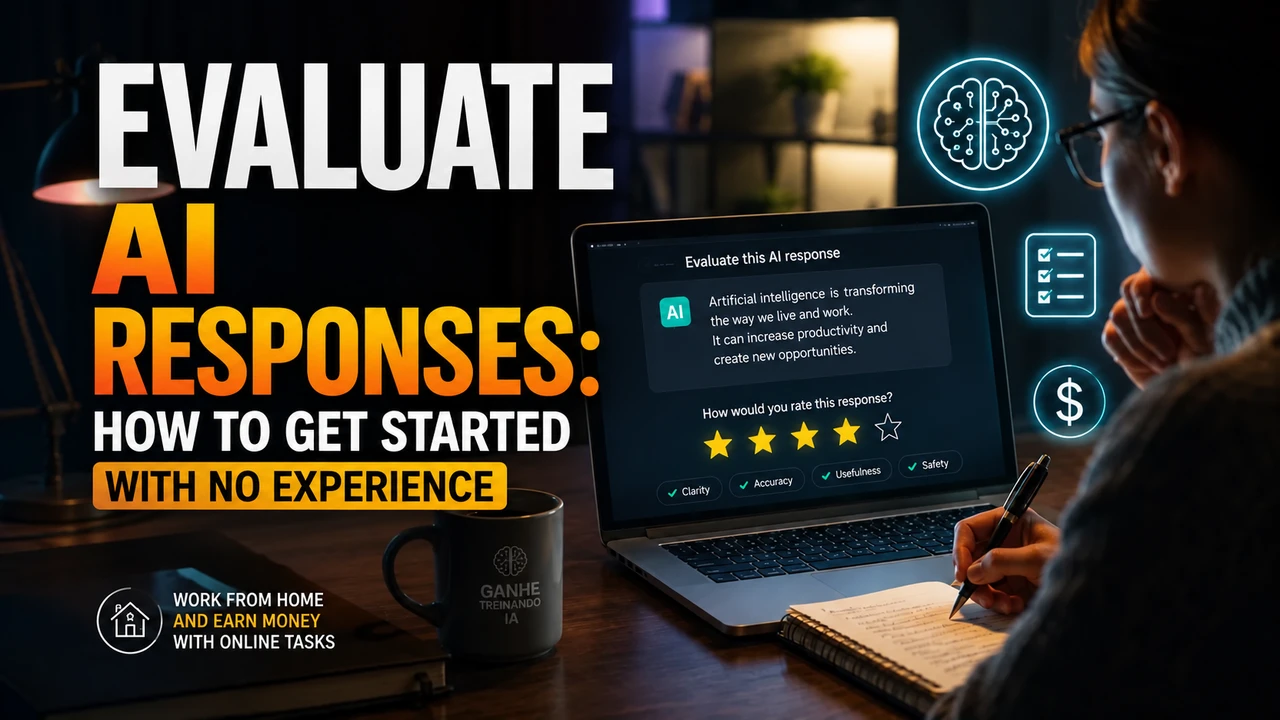
| Evaluate AI responses | Compare two chatbot responses and choose the best one, justifying the grade |
| Write questions and dialogues | Create conversation and question-answer examples in Portuguese |
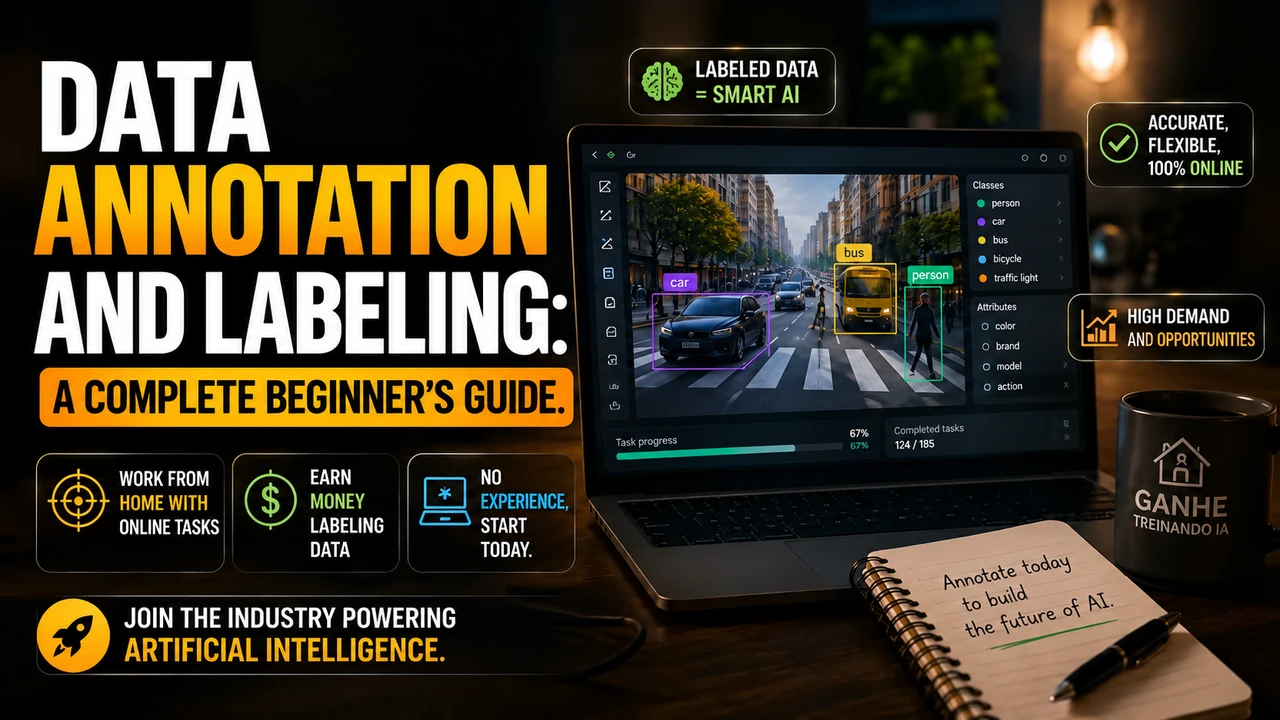
| Label and classify data | Label images, audio or text with specific categories |
| Fact check | Check whether an AI-generated response contains factual error |
| Translation and revision | Translate and review content between Portuguese and English |
The report of someone who has already done this in practice
A Brazilian journalist who worked as a data annotator reported having done translation, transcription, photo and video collection, and image labeling while still attending college. At his peak, he dedicated around 2 hours a day — 60 hours a month — and supplemented his internship income with amounts of around R$1,500 per month, varying according to the dollar exchange rate.
This type of work has existed longer than video work — companies like Appen and DataAnnotation.tech have been operating in this market for years, hiring globally, including Brazilians. The routine tends to be more flexible in terms of schedule, but requires more attention to detailed instructions than a video task.
For those with specific trainingTechnical and specialized tasks
| Task | For whom |
|---|---|
| Programming and code review | Anyone who has any experience with development |
| Mathematics and logic | Who can explain reasoning step by step? |
| Specialized knowledge | Medicine, law, finance professionals |
| Red teaming (security) | Who tests limits and security of AI models |
This is the front that pays the most, but also the one that demands the most. Specialized knowledge projects tend to directly recruit professionals trained in the required areas, with a more rigorous selection process than the simple registration of other categories, sometimes including verification of diploma or professional registration.
Comparing the tracksHow much each front pays
Higher tracks demand more from you
Recent reports cite AI response assessment and review projects paying up to $50 to $60 per hour in very specialized tasks — but they require fluent English, strict attention to instructions and, sometimes, prior technical knowledge. Video assignments remain the most accessible entry point, with no English or specific qualifications required.
To better visualize it, it is worth placing the typical ranges cited publicly for each type of task side by side:
| Category | Typical range (USD/hour) | English requirement |
|---|---|---|
| Video (POV) | $5 to $8 | Does not require |
| Voice and audio | $18 to $40 | Generally not required (native Portuguese) |
| Basic text annotation | $10 to $20 | Intermediate |
| Expert AI Assessment | $20 to $60 | Fluent |
*Approximate ranges, taken from public information on each platform and reports on the topic. Individual projects vary greatly within these ranges.
Neither hype nor exaggerationA real case: 2 hours a day, R$1,500 per month
The report mentioned above is useful precisely because it is modest and real: neither a promise of high income nor a scam. A person with another main occupation (in this case, college and internship) dedicating around 2 hours a day to note-taking, translation and collection tasks, supplementing income in a relevant amount but not replacing the internship.
This is the pattern that is repeated in most verifiable reports on this market: genuine extra income, conditioned on dedicated time and quality of delivery, never a substitute for main income. Those who come in expecting to change their lives overnight tend to get frustrated quickly; Those who come in expecting a real, well-designed complement tend to maintain the activity for longer and with more satisfaction.
The job of training AI is not a one-time job. It's a constellation of small paid tasks, and each person creates their own combination according to what they know how to do.
Where to startHow to choose which task makes sense for you
There is no universal right answer — the best category depends on your profile, your language and the time you have available. Use these questions as a starting point:
- Do you speak English fluently? AI Response Assessment and Text Annotation Open Higher Pay Ranges
- Prefer not to show up or say much? First-person video is the most discreet and accessible option
- Do you have technical training (programming, medicine, law)? Specialized projects pay significantly more
- Do you want to start without any qualifications? Video, photo and simple household chores are the easiest entry point
Not everything that glittersSigns of a scam in this market
This market grew quickly, and this attracted both serious companies and scammers taking advantage of the growing interest. It’s worth knowing how to differentiate:
Signs of a serious platform
- Pay rate visible before you accept the task
- Free registration, no entry fee
- Identifiable company, with public terms of use
- Payment conditional on quality approval (not empty promises)
Warning signs
- Request for advance payment to "release" tasks
- Promise of high fixed income without any conditions
- No information about who the company is behind
- Pressure to recruit other people instead of focusing on the task itself
The golden rule applies to any of the categories listed in this guide: money flows from those who hire to those who work, never the other way around. If at any point you are asked to pay for access, mandatory training or "certification" to release tasks, this is the most reliable sign that something is wrong.
Still in doubt?FAQ
What type of task pays best?
Specialized tasks — evaluating AI responses in English, code review, professional expertise — tend to pay more, with ranges from $20 to $60 per hour on some projects. Video and simple tasks pay less per hour but require zero prior qualifications.
Do I need to know English to work training AI?
It depends on the task. Video, photo and household tasks generally do not require English. Text assessment, writing and international data annotation projects usually ask for at least intermediate English.
Can you combine several types of tasks at the same time?
Yes, and it's a common strategy. Many people maintain accounts on video platforms and text annotation platforms at the same time, alternating depending on the availability of projects on each one.
Do these jobs have an employment relationship?
No. In the vast majority of cases you work as a freelancer or independent collaborator, without a CLT contract, without fixed hours and without a guaranteed volume of tasks.
How do I know if a new platform is trustworthy?
Check that it shows the pay rate before you accept the task, that it is free to join, and that there is clear information about the company behind it. Never pay anything to start working.
Which categories in this guide already have a specific article on the blog?
Yes! Video, voice, photos, AI assessment and data annotation already have a complete guide — check out the links below, at the end of this article.
Discover other types of tasks
Coming soon: Writing text and dialogue for AI, Translating and reviewing content for AI, Technical work: code and math