Audio transcription for AI: how to work and how much it pays
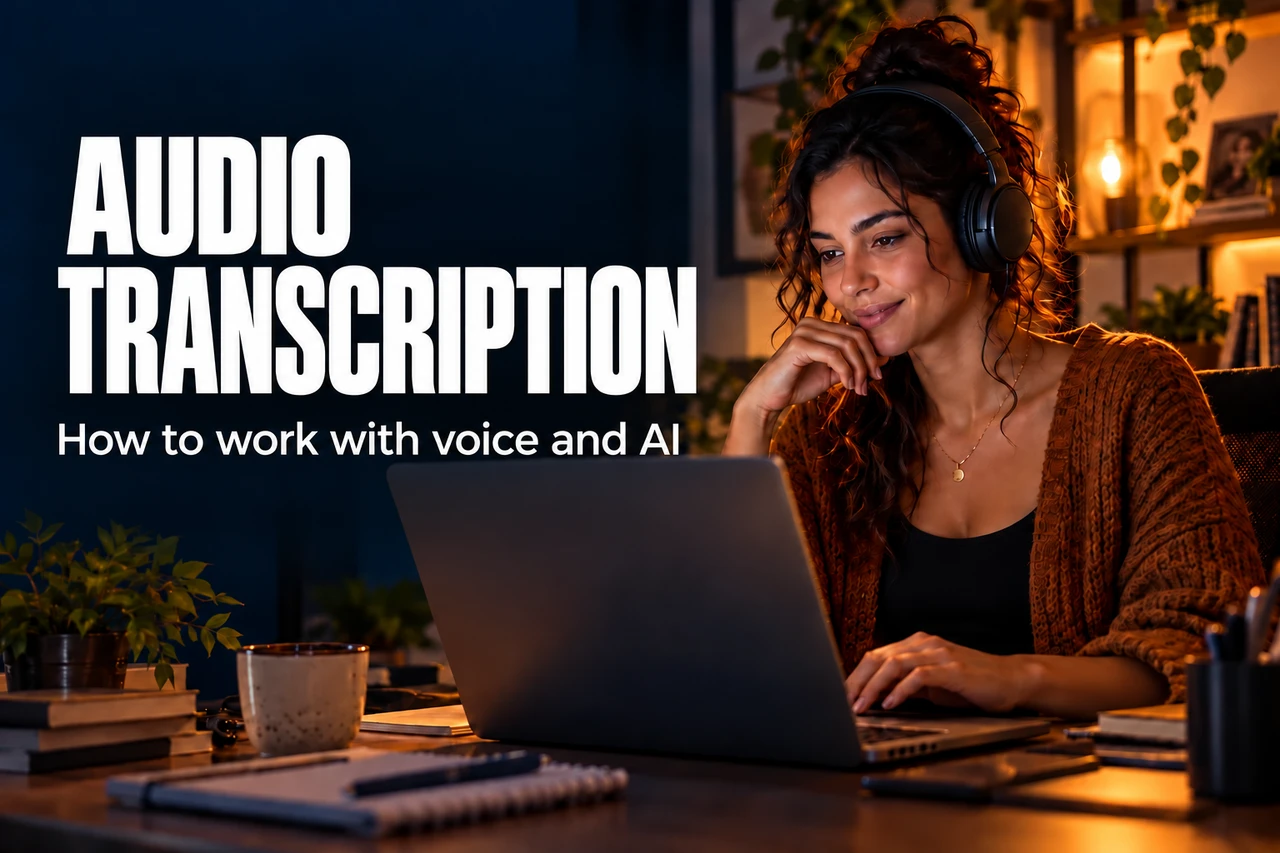
Working with audio transcription means listening to a recording and delivering a text that is faithful to the project rules. In tasks linked to artificial intelligence, this text can accompany the audio as a reference for training or evaluating speech systems. To begin with, it is better to know how to listen, write and follow instructions than to buy expensive equipment.
The main care is in the payment account: one minute of audio does not correspond to one minute of work. You may need to go back to the same passage several times, look up a spelling, and review the delivery. In this guide, you'll see how to organize this routine, evaluate an opportunity, and distinguish commercial transcription from data collection for AI.
Platform information verified as of September 29, 2026. Task conditions, selection, and availability may change.
What do people who work with audio transcription do?
The expected result is a written representation of what was said. Depending on the task, you can also identify the change of participants, position time stamps and record relevant sound events. The contractor can deliver an entire recording or small segments. In both cases, the work begins by reading the instructions, not by first clicking the play button.
Imagine a conversation about delivering a package. The person says they will receive the package on Tuesday, interrupts the sentence and corrects it to Thursday. Recording only the first date creates incorrect information. Deleting the fix without authorization can also harm the example. The decision depends on the type of transcript requested and needs to be consistent until the end.
Transcribing, recording and subtitling are different activities
Whoever records produces a new voice file. The transcriber works on existing audio. Those who subtitle need to also consider the presentation of the text in the video, such as division into blocks and synchronization. A vacancy may combine stages, but it is not wise to assume that the same rate or tool applies to all of them.
If you prefer speaking rather than listening and typing, the voice recording guide for training AI presents the other part of this process. Here, the focus is on producing and reviewing transcripts, paying attention to the time required to deliver a reliable file.
How can a transcript help train AI?
A speech recognition system needs to match sounds to words. Audio and text pairs can provide examples for this learning; Transcripts can also serve as references in assessments. The scientific work Robust Speech Recognition via Large-Scale Weak Supervision describes a training approach with large volumes of audio and transcripts. This explains the technical usefulness of this data, not the destination of any file found on a platform.
An interview transcribed for a researcher, a meeting converted into minutes, and a set of annotated speech for AI are different contracts. Before accepting, look for the purpose described in the project. If the ad only mentions transcription, don't conclude that you will be training artificial intelligence. And, even when there is use in AI, this does not confirm direct application in a specific humanoid robot.
For those who work, this distinction has practical consequences. A text intended for reading may favor fluidity; a linguistic reference may require that certain repetitions remain. The quality criterion is suitability for the order. Writing a more elegant version does not compensate for the loss of information that the project wanted to preserve.
What formats appear in tasks?
| Format | What to watch out for | Question before starting |
|---|---|---|
| Literal transcription | Repetitions, hesitations and interruptions according to the manual. | What elements of speech should remain? |
| Clean transcript | Removals permitted without changing the meaning. | Does the project define what can be removed? |
| Draft review | Comparison of the text provided with the audio. | Do I need to review the entire file? |
| Segmentation and tagging | Limits on sections, participants and times. | What unit and precision are required? |
These categories help you read advertisements, but do not replace the manual. Nas official GoTranscript guidelines, for example, there are specific rules for literal transcription, clean transcription, identification of participants and marking of incomprehensible passages. The document advises not to reconstruct speech on your own. Use this reference to understand the level of detail possible; on a task from another company, follow their instructions.
One sentence, two possible decisions
Consider this made-up example: “I, I turned in the form on... on Wednesday, I mean, on Thursday.” A literal exercise can preserve attempts and self-correction. An editing exercise may call for a clean version. Before removing any part, identify whether the date correction carries meaning and whether the rule allows you to condense it. Don't choose what looks prettier.
How to deal with a real listening doubt
Go back a few seconds, listen to the entire phrase and compare the excerpt at normal and reduced speed, when the tool allows it. If you are still unsure, apply the authorized appointment or use the doubt channel. Don't turn an assumption into a confirmed word. An honest indication of uncertainty is often more useful for review than a convincing-sounding made-up name.
Equipment: what is needed to get started?
A practical setup is a computer with a comfortable keyboard, headphones and a stable connection. The computer makes it easy to switch between instructions, editor, and search. The headset helps you understand speech without exposing the recording to the environment. Before purchasing anything, check the technical requirements of the position and test what you already have with your own audio.
A cell phone can be used to follow messages and study rules, but a small screen makes it more difficult to review long texts and control markings. This is an ergonomic limitation, not a universal prohibition. If the project has its own app and accepts tasks over the phone, evaluate the real experience before taking on a volume of deliveries.
Transcription pedal, second monitor, and specialized keyboard can all come in handy once you know your flow. They are not a mandatory first step for this exercise. Measure where the difficulty is: if the problem is understanding the accent or applying the manual, an accessory won't solve it. Prioritize guided practice and an environment in which it is possible to maintain attention.
Take a test before spending
Record a minute of your own voice reading a text you wrote. Transcribe without looking at the original and compare later. The exercise reveals problems with listening, typing and proofreading without relying on confidential material.
A workflow to deliver with less rework
1. Read the order and turn rules into decisions
Before listening, write down the language, regional variant, format, deadline and handling of doubts. Check whether there are approved examples and whether the task allows for external tools. Create a short reminder with decisions that affect delivery. Avoid copying the entire manual: the goal is to quickly find what you tend to forget.
2. Do a reconnaissance listen
If a preview is available, use it to understand the number of participants, noise and subject matter. Once you take on the task, identify changes in voice and recurring terms. This first pass helps to organize the work. It does not authorize downloading or saving the file outside the permitted environment, nor does it guarantee that the remainder will have the same difficulty as the beginning.
3. Work in short snippets with context
Choose a range that you can understand without relying solely on memory. Type, go back to the beginning of the sentence and check. Cuts that are too small can hide the intention; excerpts that are too long encourage omissions. Adjust the size during practice. The best rhythm is the one in which you can justify the words delivered, not the one that produces the most characters on the first pass.
4. Separate research from guesswork
Looking up the spelling of a clearly mentioned product can be helpful. Searching for a person to try to guess something you don't hear is another behavior. Register the question, consult only authorized sources and return to the audio. Never send the recording to an external service just because the tool promises to find out the name or clean up the noise automatically.
5. Review following the sound
A silent review finds clerical errors but does not confirm fidelity. Go through it comparing audio and text, paying special attention to negations, numbers, names, and participant changes. Then check the final format. If there is a save draft button, confirm that it works before relying on it; keep copies only when the contract allows.

How much does audio transcription pay?
There is no universal value. In consultation with the GoTranscript's official Portuguese job page, on 09/29/2026, the company advertised US$0.50 to US$1.20 per minute of audio. The page mentions candidates from Brazil, selection with testing and weekly payments via PayPal, Payoneer or USDC. These are terms disclosed by the company, subject to offer and approval; They do not represent guaranteed pay or prove that each task will be used for AI.
The decisive point is the unit charged. If the payment takes into account the duration of the file, repeating the audio ten times does not increase the paid minutes. If the offer pays per task, you need to find out what is included. If you pay by the hour, check how time is recorded and which activities count before you start.
Example of effective hour calculation
Imagine a fictitious proposal of US$0.60 per minute of audio. A ten-minute file would have a gross value of US$6. If you spend forty minutes listening, transcribing and reviewing, the equivalence will be US$9 per hour of work. If you spend eighty minutes, it drops to $4.50. The values are a simulation, not a productivity prediction.
| Illustrative scenario | File value | Total time | Gross equivalence |
|---|---|---|---|
| 10 minute archive | $6 | 40 minutes | $9/hr |
| Same file | $6 | 80 minutes | $4.50/hr |
To compare your first deliveries, record audio length, execution time, review, and approved value. Calculate in the same currency. Receipt fees, currency conversion and applicable obligations may reduce the amount available; check these items with the providers involved. Do not multiply an advertised rate by a monthly journey as if there were continuous work.
How to evaluate an opportunity in Portuguese
Start with the company's official address, accessed directly. Read the activity description and confirm country, language and requirements. A page that accepts Portuguese does not necessarily accept any regional variant or place of residence. Save the opportunity title and inquiry date so you can compare a later message with the ad you actually read.
Before filling out a long test, identify who pays, what the pay unit is, how approval works and if there are any costs. Registration, profile approval and receiving tasks are different steps. The absence of files in the account does not authorize purchasing access from third parties. It's also not worth using someone else's identity to try to enter an offer.
A simple spreadsheet can help: record official address, language, requirements, test, announced payment and application status. Do not include passwords, documents or recordings in this control. This way you can follow the process without relying on memories and realize when you are spending many hours on registrations without a concrete proposal to analyze.
Quality: how to find the mistakes that matter most
In your practice, organize errors by type. “I didn’t hear the denial” calls for a different review than “I used the wrong format for the time.” Separating listening, writing and formatting allows you to correct the cause. Repeating the same exercise in its entirety without diagnosing the problem can consume time without improving the result.
Use three short passages: first meaning, then details, last presentation. First, look for omissions and changes that change the message. In the second, check numbers and names. In the third, apply identification and time standards. This is a personal organization proposal; the order required by the task and the contracted deadline continue to prevail.
The Common Voice spontaneous speaking guidelines illustrate how a set of data can value hesitations, repetitions and grammatical variation. This community reference is not a job offer. It shows why “correcting” the way you speak without reading the manual can remove precisely the information you want to record.
Privacy and use of automatic tools
Treat files as service-restricted material. Avoid playing an interview on loudspeaker near other people, leaving the screen open in shared spaces, or sending excerpts to friends. If a question arises, describe the problem to authorized support, using only the necessary identifiers. A request for help does not need to expose the entire content.
Don't assume an automatic transcriber, translator, or chatbot is cleared. The project may allow automatic drafting, provide its own tool, or require human execution. In addition to quality, there is the destination of the sent file. The safe decision is to confirm the rule before sending, even when the external tool appears to be free and does not ask for registration.
To study, prefer your own recordings or material with authorization compatible with the exercise. An interview received from a client does not become a portfolio because it was transcribed by you. When terminating your service, follow the retention and deletion guidelines. If they are not clear, ask for clarification, without deciding on your own to publish or share samples.
How to practice for a week
On the first day, test your environment with your own audio and record the time spent. In the second, repeat paying attention to the punctuation. In the third, introduce two authorized voices and monitor participant changes. There is no need to imitate a specific selection: the goal is to discover how you listen, organize questions and revise.
On the fourth day, try applying a short set of rules that you have defined for the exercise. Fifth, review an old delivery without looking at your notes. In the sixth, compare the types of error and only train the most frequent. In the seventh, read a real opportunity and see if your resources and availability match it.
This plan does not guarantee approval. It creates a basis for evaluating effort before making commitments. If the activity doesn't suit you, there are other fronts in the pipeline. landscape of paid AI training jobs. To better understand how rules and labels organize data, also see the data annotation guide for beginners.
Audio Transcription FAQ
Do I need experience to start?
It depends on the offer. There are selections that accept beginners, but this does not eliminate language tests and instructions. Before applying, practice with your own audio and assess your ability to revise what you have written.
Is it mandatory to speak English?
Not in every task. The audio may be in Portuguese, while the training or support uses another language. Check separately the language of the content, instructions and communication with the platform.
Can you work just on your cell phone?
Only if the platform and task accept it. For long texts, a computer and keyboard tend to make proofreading easier. Test the required environment before promising a deadline or purchasing equipment.
Does an hour of audio mean an hour of work?
No. The length of the file is different from the time needed to transcribe. Repeated listening, research, and review go into your effort, even when payment is calculated only per approved minute of audio.
Can I use AI to do the transcription?
Only when the rules authorize the tool and the sending of the file. An automatic result may also need complete review. Do not use external services on confidential material without permission.
Should I correct the speaker's Portuguese?
Follow the manual. A faithful transcription can preserve informal constructions and repetitions. Rewriting to improve the style can change the data. Transcription, editorial review and summary are not equivalent deliverables.
How to act when I don't understand a word?
Relisten with context and use allowed features. If the question persists, apply the marking defined by the project or consult support. Don't make up a word just to make the sentence complete.
Will every transcript be used to train robots?
No. The destination depends on the contract. There are non-AI commercial transcriptions and speech projects aimed at other systems. Do not associate a task with specific robots without express confirmation.
How do you know if the pay is worth it?
Compare the approved amount with all the time you spent, including review. Consider receiving costs and actual job availability. Use your first deliveries as a reference, without treating a simulation as predicted income.
Links to sources cited in this guide are not referral links. The purchase links identified in the sidebar may generate commission for the portal, at no additional cost to you.