Make Money Training Humanoid Robots with Everyday Videos
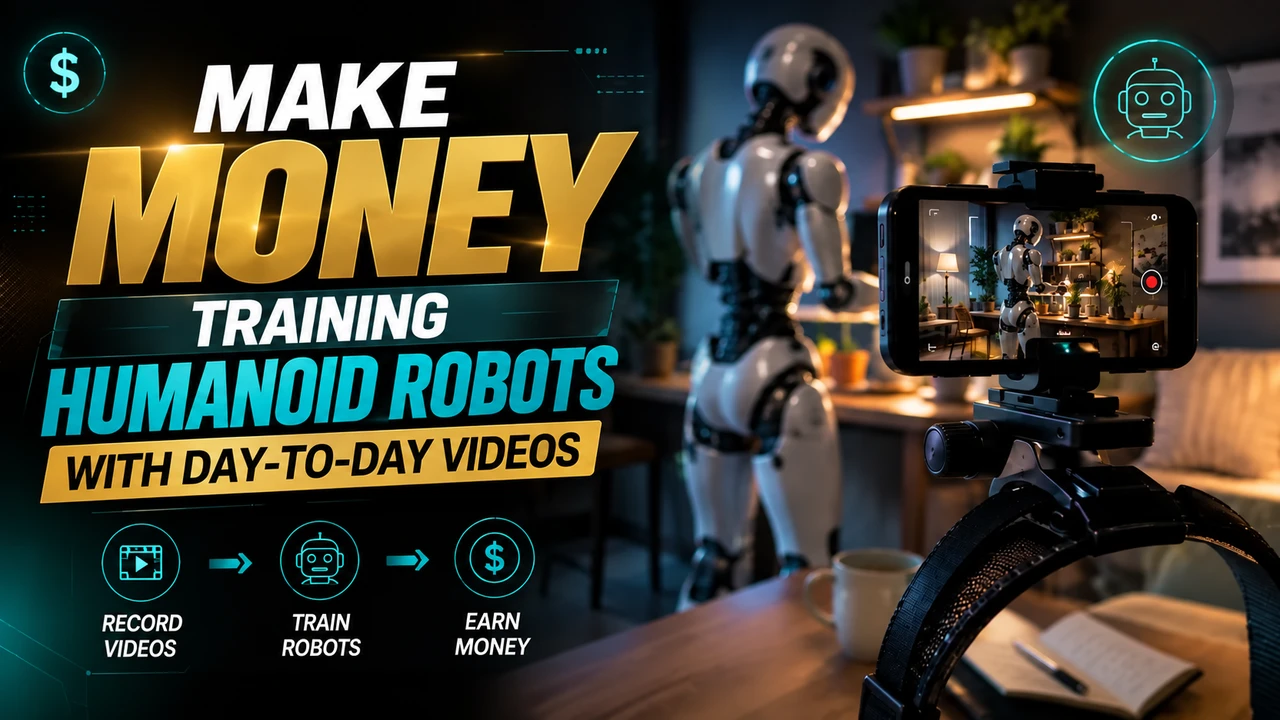
A humanoid robot is not born knowing how to fold a towel. He learns the same way any of us learned: by watching someone do it over and over again. The difference is that, in the case of the robot, that "someone" is a video — and there is a real chance that that video is yours.
This article complements the complete guide on recording videos to train AI going deeper into the part that arouses the most curiosity: what exactly is being built on the other side, and why this specific type of video is so valuable to the sector. Understanding this context doesn't change what you need to do in practice, but it helps you understand why companies are willing to pay for something as simple as you folding a towel.
The robotics bottleneckThe problem that robotics needed to solve
After years of training language models with practically all text available on the internet, the AI industry has reached a known limit: it is not possible to "scrape" data from the internet that simply does not exist ready-made. Video of human hands doing real-world tasks, in first person, with quality metadata, is that kind of scarce data.
A robot doesn't learn to wash dishes by reading an instruction manual — handwritten rules for every micro-movement quickly explode in complexity. He needs thousands of real examples of how human hands hold a sponge, apply pressure, spin a plate. It's this collection that was missing, and it's this collection that platforms like Hub Data, Claru, Crowtado and others are now building, one video at a time.
The technical part, without complicating itHow a robot learns by watching you
The models used in this type of training combine three things: computer vision (understanding what is in the image), language (understanding the instruction "wash the dishes") and action (translating this into motor commands for the robot's arms and hands).
Technical curiosity
The term used by researchers is VLA — Vision-Language-Action. It's the same type of model used by Figure AI in the Helix robot: the robot observes a human doing a task — like serving coffee — and learns the sequence of movements from there.
Recent research in robotics — including academic projects like EgoVLA, which specifically uses human egocentric video — shows that the model learns by associating the movement of the human hand in the video with a sequence of actions that the robot can reproduce. It's basically teaching by imitation, on an industrial scale.
Think about how to teach a child
You don't teach a child how to tie a shoelace by writing a physics manual about knots and rope tension. You show, she observes, she tries, makes a mistake, tries again. Robots trained with human video learn in a similar way — by repeated demonstration, not by written rule.
Who is paying this bill?Who is chasing this data?
The appetite for this type of information is not small. Companies like Figure AI (which has already raised hundreds of millions of dollars in investment rounds), Tesla with the Optimus project, and Chinese manufacturers such as Unitree e Agibot compete to get humanoid robots working in factories, warehouses and, eventually, homes.
Financial sector executives are already calling physical robotics the next frontier of technology investment — on the same level as the race for language models in recent years. And this whole race runs into the same bottleneck: there is a lack of people willing to record their daily lives.
It's not just a conceptWhat's already really running
It's worth separating hype from reality here. A relevant part of this robotics has already left the laboratory: Amazon operates a fleet of more than 1 million robots carrying out separation and logistics autonomously in its distribution centers. In China, humanoid robots already work in factories, hotels and even hospitals — manufacturer Agibot even broadcast live its G2 robot operating on a real production line, not a controlled demonstration.
This doesn't mean a robot will appear in your kitchen next year. Most of these implementations are still pilot projects, concentrated in a controlled industrial environment. But it shows that the money invested is becoming a product, not just a presentation slide — and each new robot that goes into operation consumes a huge amount of training data to get there.
What happens after you press sendThe path of your video
After you submit the recording, the material goes through an analysis process that combines artificial intelligence and human reviewers. A first automatic filter checks basic technical issues — framing, lighting, duration. Then, human reviewers check whether the task really corresponds to what was requested and whether there is no privacy problem in the scene.
Only the material approved in both stages enters the database that is actually used to train the models. That's why payment is conditional on approval — the company only has a commercial interest in the video that passes this quality check.
The question everyone asksWhy human hands and not just simulation?
Sophisticated physics simulators exist and help a lot — companies use platforms like NVIDIA's Isaac Sim to train entire warehouse scenarios before touching a real robot. But simulation has a limit: it reproduces what engineers thought of modeling, and the real world is full of details that no one thinks of simulating.
The exact way a wet towel behaves when folded. The amount of force needed to hold an egg without breaking it. How the light in a real kitchen changes throughout the day. These "dirty" details of the real world are exactly what human video captures for free — and what pure simulation still struggles to faithfully replicate.
Returning to concreteYour real role in this process
You don't need to understand any of this to participate — this section is just to satisfy the curiosity of those who want to know where the video ends. In practice, your role is simple: perform the task normally, with your cell phone recording from your point of view, and let engineering on the other side do the rest.
Want to understand how to really start recording, including equipment and first recording? O complete guide There is a step-by-step guide from zero to the first payment.
A little contextFrom written rule to imitation
It is worth understanding why this moment is different from previous attempts at domestic robotics, which have been promised for decades without getting off the ground. The old approach was to write rule by rule: "if the fabric bends more than X degrees, adjust the gripper by Y centimeters." It works for a specific scenario, but it breaks as soon as something changes — a different shirt, a different light, a table at a different height.
The turning point came when researchers began to train these systems with large volumes of video, sensors and simulation, instead of relying solely on hand-programmed rules. Projects like Google's RT-2 and OpenAI's Dactyl were some of the first to show that robots could generalize to never-before-seen situations, as long as they had seen enough examples of similar situations. It is this logic of “the more examples, the better the generalization” that underpins the entire data collection industry that you are learning about here.
There is even a more recent strand of research seeking the opposite path — teaching robots with much less data, more efficiently, instead of simply piling on more video. But until this approach matures on a commercial scale, real-world data recorded by everyday people remains the most reliable foundation the industry has at its disposal today.
Still in doubt?FAQ
Will my video train a specific robot, like Tesla's Optimus?
Probably not a specific, famous model — collection platforms sell data to various laboratories and robotics companies, which are generally not publicly identified. But yes, the data type is exactly what companies like Figure, Tesla and others use.
Why can't a robot learn from computer simulation alone?
Simulation helps a lot, but the real world has variations that are difficult to simulate perfectly — the exact way a towel falls, the friction of a wet sponge, the right force to avoid breaking a plate. Real video captures these nuances in a way that pure simulation still doesn't fully replicate.
Will robots steal domestic jobs?
It's a legitimate long-term concern, but humanoid robotics is still in the pilot phase, particularly in manufacturing and logistics. Genuinely capable home robots still rely on much more training data than exists today.
Will this data market dry up at some point?
Demand may shift in focus as models evolve, but the need for real-world data is ongoing — new task types, new environments, and new objects continue to require fresh recordings.
Do I need to understand technology to participate in this?
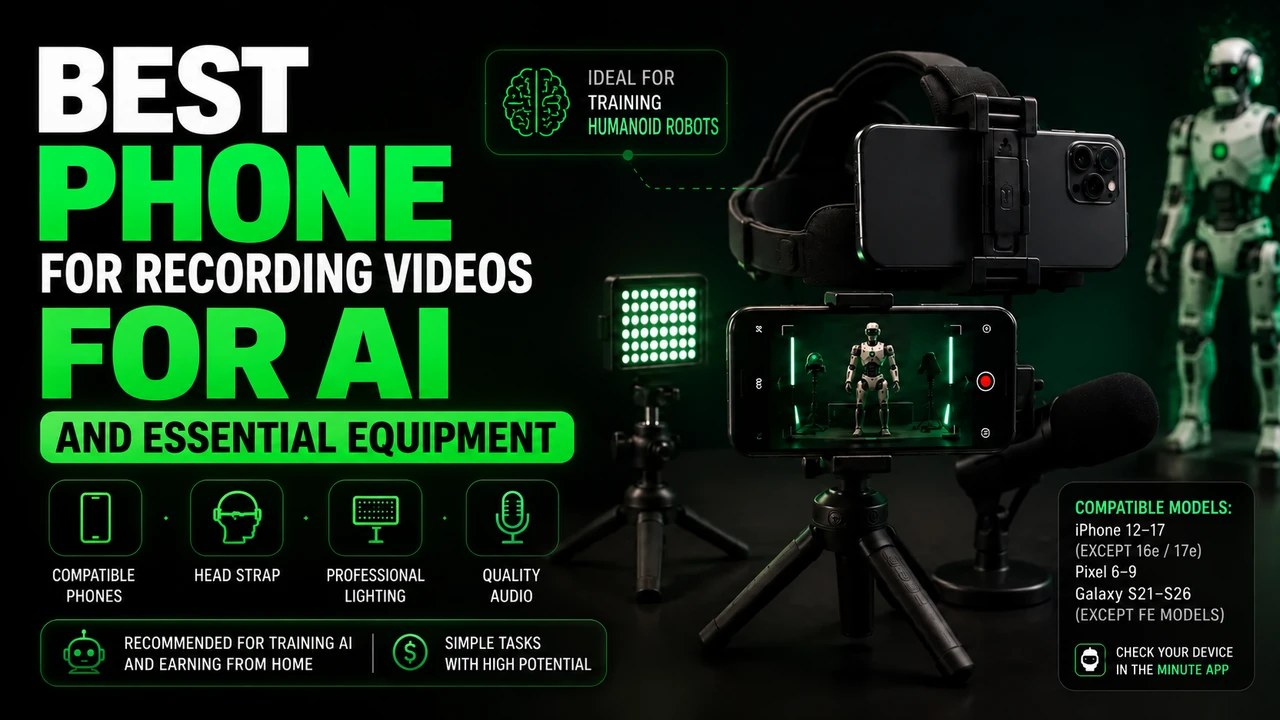
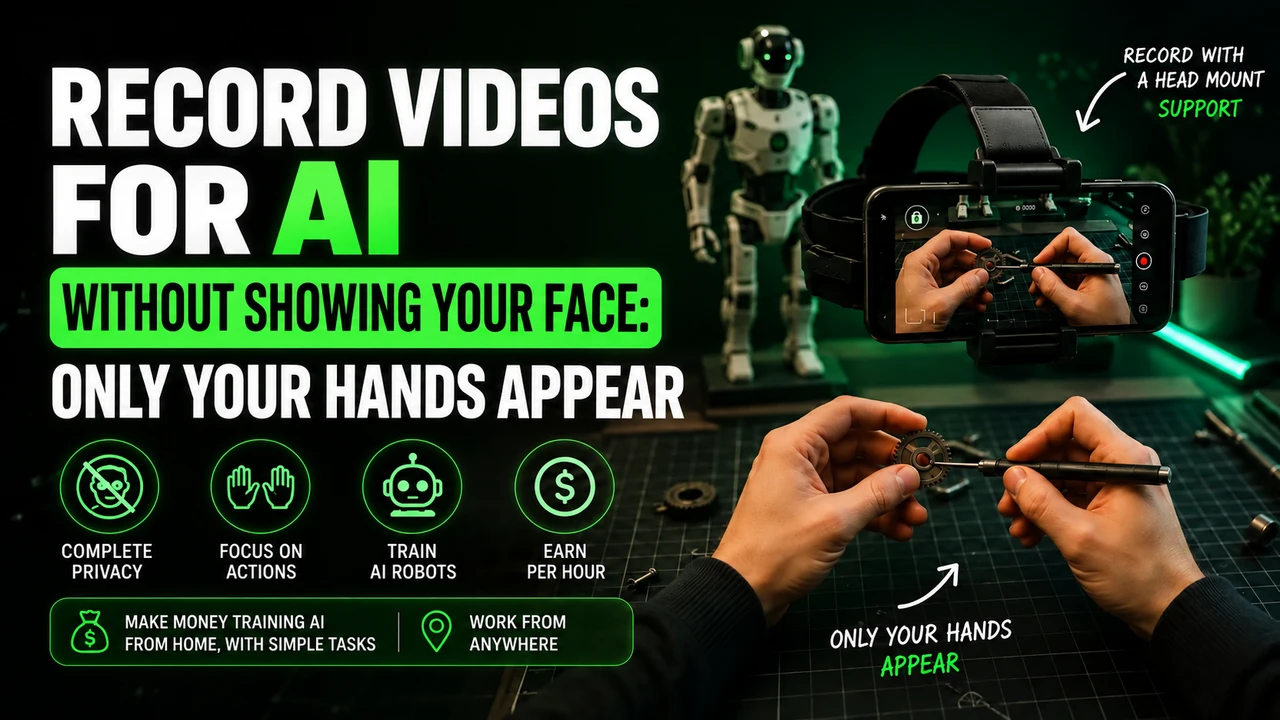
No. You just need to perform your household chores normally, with your cell phone secured to the headband. All model processing and training happens on the company's side.
Who reviews whether my video will actually be used?
The process combines automatic analysis (framing, duration, lighting) with human review, which checks whether the task corresponds to the request and whether there are no privacy issues. Only after these two steps does the video actually enter the training base.
Keep learning about recording